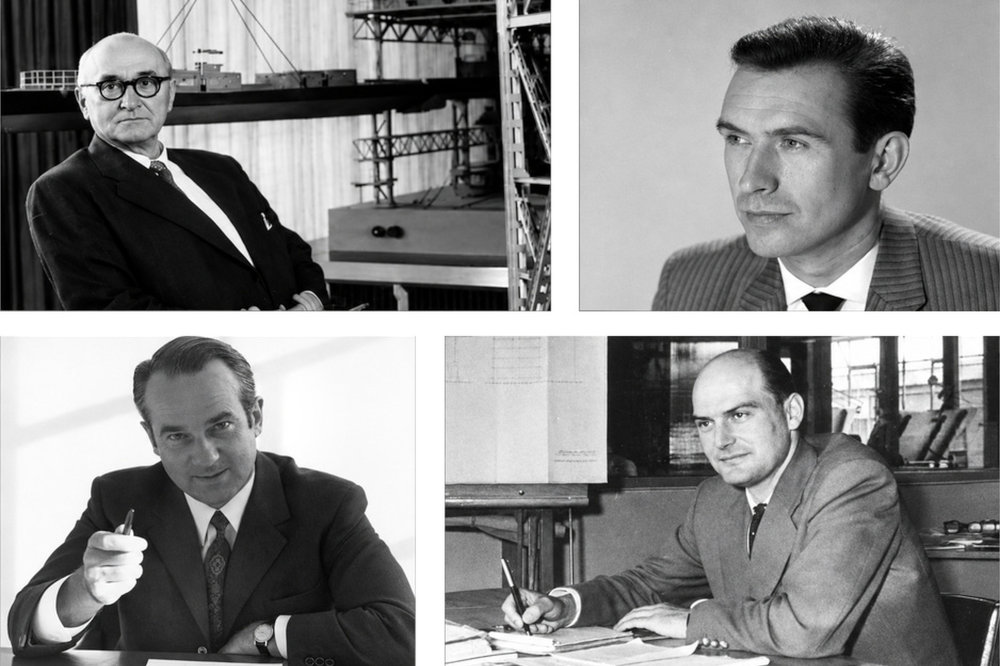
Kurt Baumann, Heinz Hasselmann, Reinhard Mohn, Hans Reuter
The Pioneers of High-Bay Warehousing
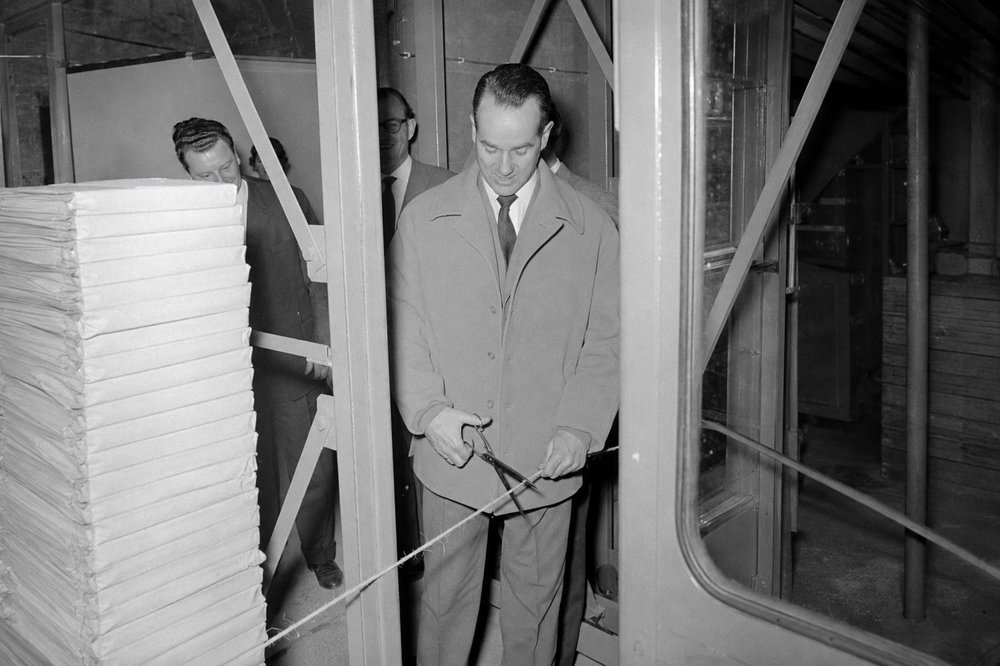
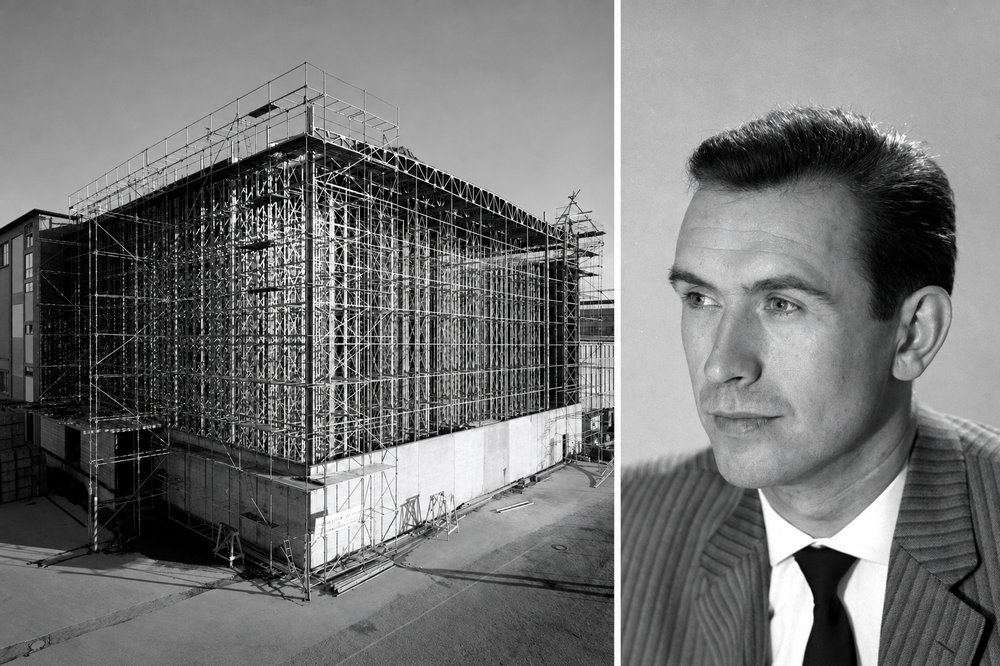
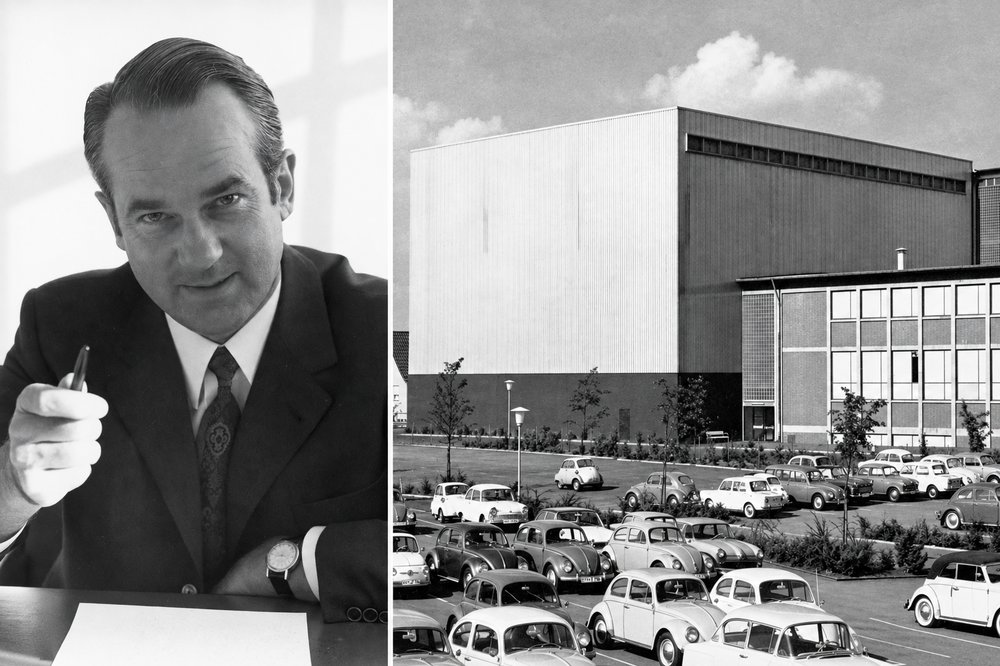
Automated high-bay warehousing marked the beginning of a new era in logistics and became the starting point for the worldwide development of modern high-bay warehouses. In recognition of this pioneering achievement, the Logistics Hall of Fame inducts Kurt Baumann, Heinz Hasselmann, Reinhard Mohn and Hans Reuter, who laid the foundation for modern automated warehousing with the Bertelsmann “book silo".
| Industry | Intralogistics, mechanical engineering mail-order business |
| Country | Germany |
| Inducted into the Logistics Hall of Fame | 2026 |
-
Merits
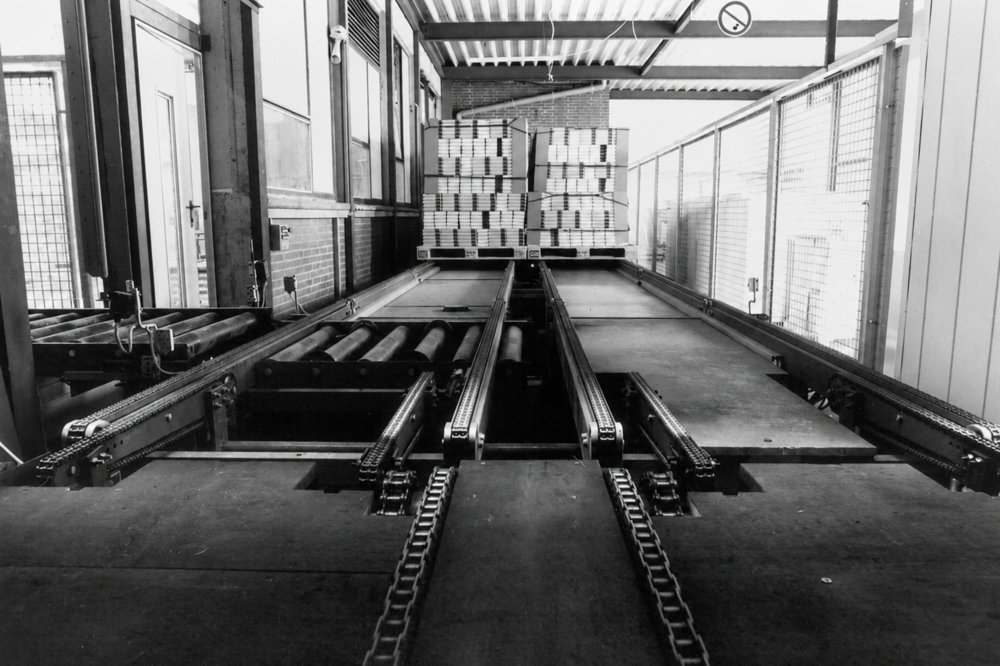
- In the 1950s, manual labor, counterbalance and warehouse trucks, and floor-level conveyor technology dominated warehousing. Goods were primarily stored at floor level and therefore required considerable space, particularly when heavy components were involved. Demand-oriented control of material flow and order picking was virtually impossible. The automated high-bay warehouse commissioned in 1962 at the Bertelsmann publishing company in Gütersloh – the so-called “book silo” – is regarded as the first practically deployed high-bay warehouse system with an automated storage and retrieval machine and as a milestone in intralogistics. It marked the beginning of a new generation of automated storage technology and became the starting point for the worldwide development of modern high-bay warehouses.
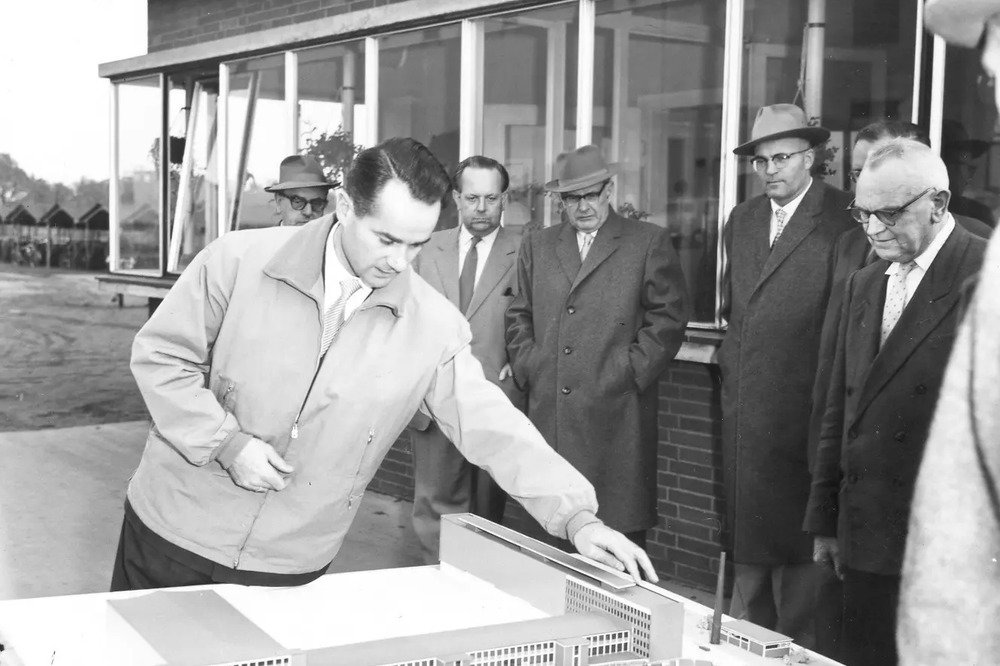
- This pioneering achievement was the result of close cooperation between visionary entrepreneurs and outstanding engineers. Reinhard Mohn and Kurt Baumann represented the client, while Hans Reuter and Heinz Hasselmann represented the technology partner. Together, they initiated, designed and implemented the project, laying the foundation for modern warehousing.
- The high-bay warehouse was less the result of a single invention than a systems innovation in industrial logistics during the 1950s and 1960s. The interaction of several developments – including the standardization of the Euro pallet, advances in structural steel construction and the automated storage and retrieval machine – made it possible to automate storage at great heights. Germany played a key role in this development, as material handling technology manufacturers, steel construction companies and mail-order businesses worked together here to develop and deploy these systems on an industrial scale for the first time.
- The Bertelsmann Book Silo in Gütersloh: Milestone in Logistics History
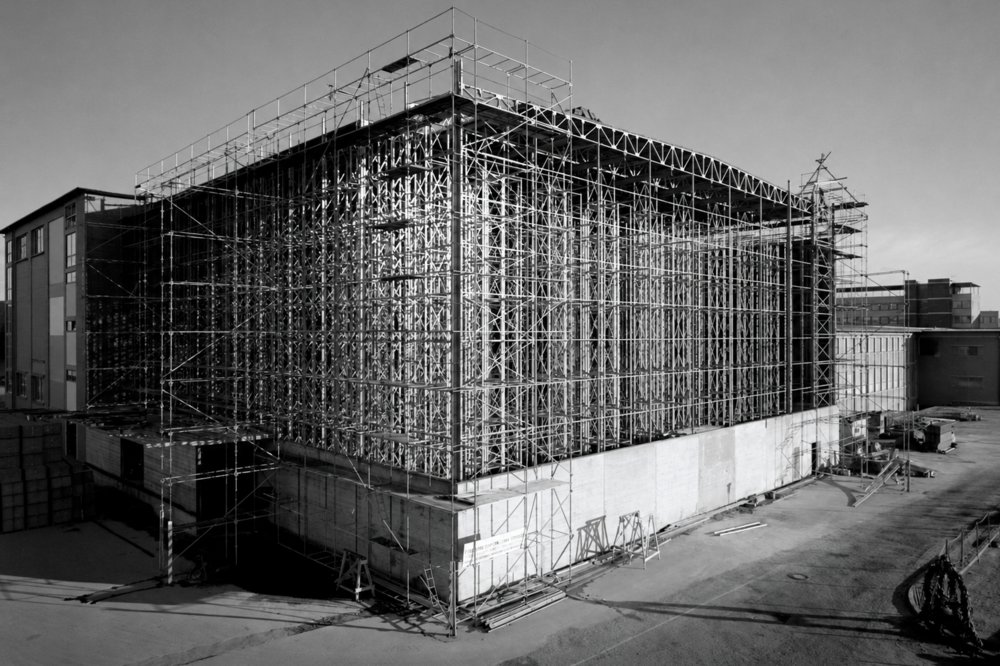
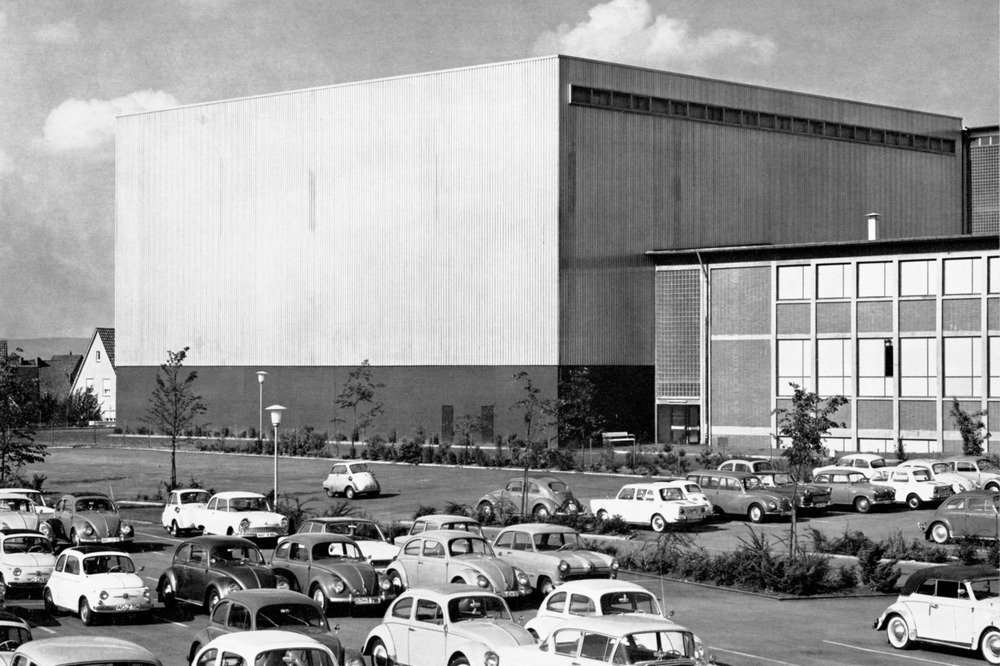
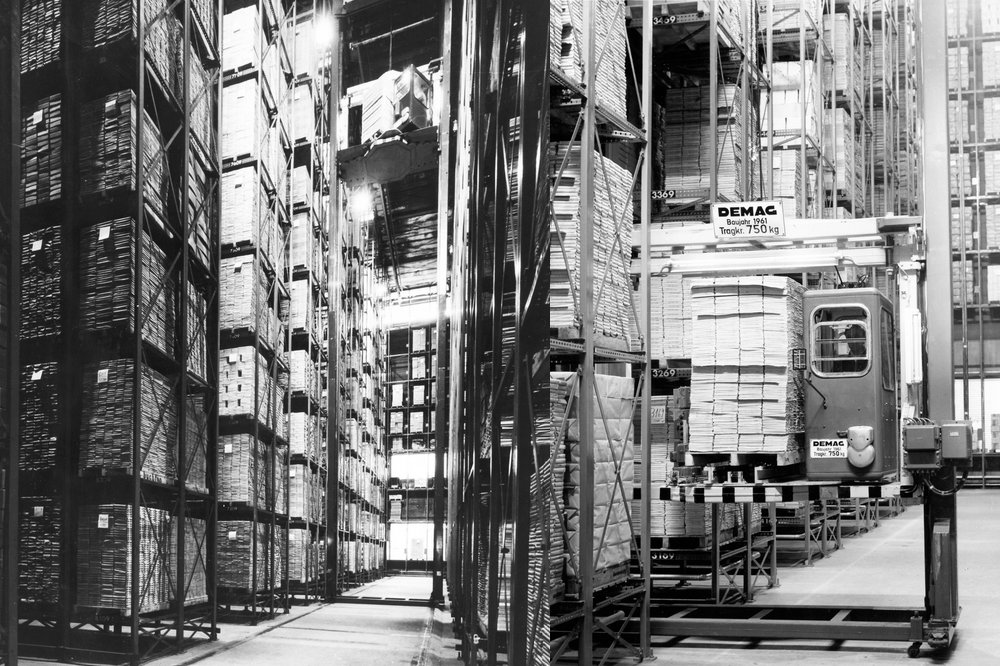
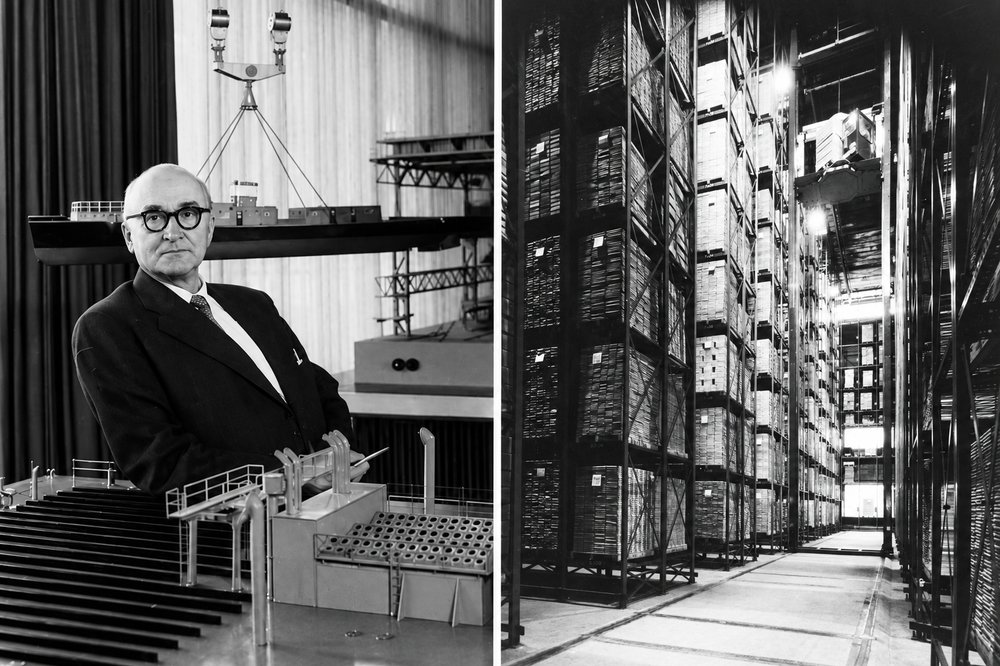
- The first automated high-bay warehouse was originally developed not for palletized goods, but for books. Construction of the new warehouse began in the summer of 1961. By March 1962, the approximately 20-meter-high book silo was operational, with a capacity of up to seven million books – a pioneering achievement in both technology and logistics. The rack structure also served as the load-bearing structure for the roof and walls, making it one of the early high-bay warehouses built using a silo construction method. The objective was to combine maximum use of space with largely automated storage operations.
- The initiative for the new facility arose from the rapidly growing order volume of the expanding book business. Beginning in 1960, Kommissionshaus Buch und Ton (KBT) also provided services to publishers outside the Bertelsmann Group. The new facility on Friedrichsdorfer Straße, now Carl-Bertelsmann-Straße, made it possible to close three external warehouses and bring administration and warehousing together at a single location – an important step in optimizing logistics processes.
- The Development of the Automated Storage and Retrieval Machine
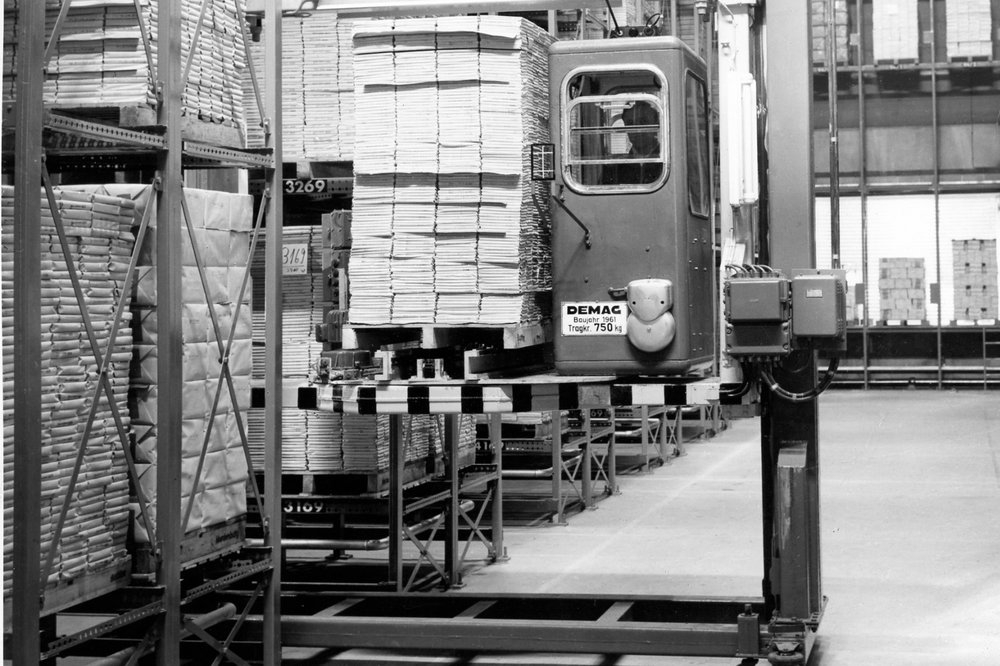
- As early as the late 1950s, Demag developed the concept of a storage and retrieval machine capable of moving both horizontally and vertically – essentially a combination of a crane and a forklift. Engineers involved in this development included, among others, Friedhelm Podswyna, Horst-Werner Ruttkamp and Werner Kühn. They developed a system with mobile, rotating masts on which load-handling devices could move vertically. While the first designs were still guided from the ceiling of the warehouse, the floor-guided design soon became established, offering significantly greater stability and flexibility. This made it possible, for example, to access individual aisles more quickly, more frequently and with greater precision.
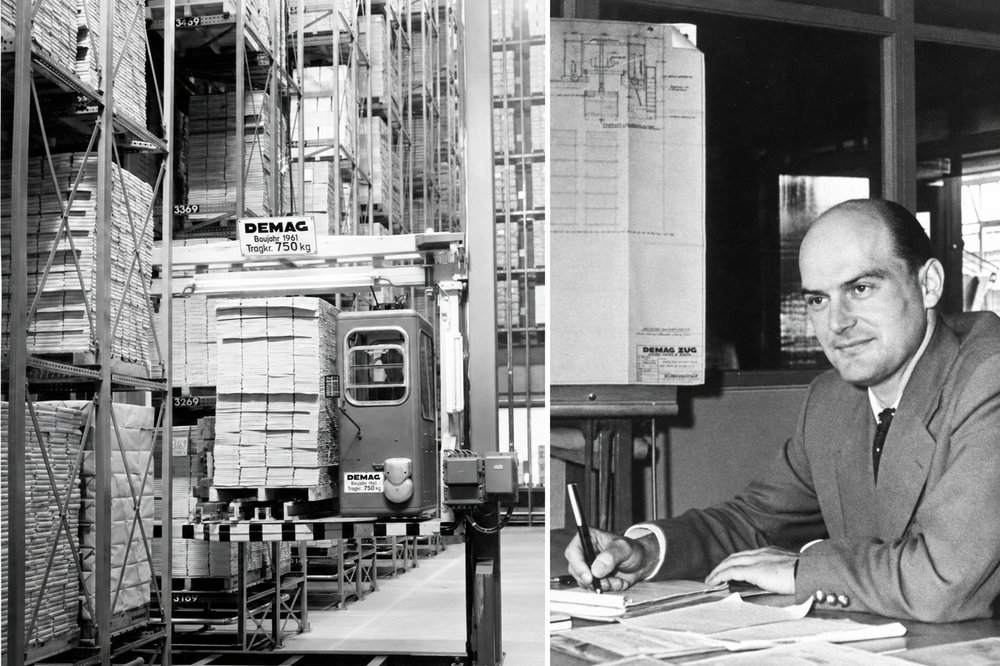
- The technology was further developed significantly as part of the Bertelsmann project. The storage and retrieval machine installed in 1962 could initially be operated manually from a cabin on the mast, but it was already designed for automated operation using punched-card control.
- Heinz Hasselmann’s 1963 patent describes a “stacking machine with a load-handling device for transferring the load received on the load carrier” and is regarded as one of the technical milestones on the path to the modern automated storage and retrieval machine.
- Whether the development of the storage and retrieval machine can be attributed to a single individual has never been conclusively established. What is clear, however, is that the practical application of this technology, which made the automated high-bay warehouse possible, was the result of close cooperation between Bertelsmann and Demag, as well as the work of numerous engineers and practitioners.
- Lasting impact
- The concept quickly spread beyond Germany. The high-bay warehouse became a blueprint for modern warehousing – automated, space-efficient and highly efficient. Comparable facilities were built as early as the 1960s and 1970s, including at Quelle, Thyssen and later at numerous industrial and commercial companies. With the introduction of computer-controlled systems in the 1970s, the transition to digitally controlled warehousing began.
- Today, fully automated and robotized high-bay warehouses are standard worldwide in intralogistics. They enable efficient, space-saving and resource-efficient supply for industry, commerce and society and are an integral part of modern logistics systems.
-
Kurt Baumann
Kurt Baumann was a German sales and logistics manager at Bertelsmann. As Managing Director of Kommissionshaus Buch und Ton (KBT), he was responsible for the distribution of books and records and drove the development of efficient, increasingly automated warehousing and shipping structures. In contemporary industry reports, he was also referred to as Bertelsmann’s “distribution guru.”
Baumann analyzed the logistical challenges posed by the rapidly growing mail-order business and defined the functional requirements for a new type of warehouse system. As the customer and first user, he created the practical use case for which the new technology was developed and in which it could be deployed industrially for the first time. In doing so, he made an important contribution to the Group’s expansion and laid one of the foundations for Bertelsmann’s subsequent logistics and services business.
2026 Inducted into the Logistics Hall of Fame
-
Heinz Hasselmann
Heinz Hasselmann, born on November 19, 1936, and deceased on June 12, 2009, was a design engineer at Demag Zug GmbH and one of the pioneers of automated warehousing technology in the 1960s.
Hasselmann developed and improved key components of warehousing technology and filed a patent in 1963 for a rack-stacking device—the term used at the time for what later became known as a storage and retrieval machine (Patent DE 1229454 B). His design is regarded as one of the technological foundations of automated high-bay warehouses.
2026 Inducted into the Logistics Hall of Fame
-
Reinhard Mohn
Reinhard Mohn, born on June 29, 1921, in Gütersloh and deceased on October 3, 2009, in Steinhagen, is regarded as the post-war founder of Bertelsmann. After returning from American captivity as a prisoner of war, he assumed management of the family business in 1947 and transformed the medium-sized publishing company into an international media group. By establishing the Bertelsmann Lesering book club in 1950, he laid the foundation for the company’s rapid growth. In 1977, he founded the Bertelsmann Stiftung.
Mohn initiated the construction of the Book Silo and personally drove the project forward. In response to the rapid growth of the book and record mail-order business, he decided to build what was then a completely novel automated high-bay warehouse—the first of its kind anywhere in the world. It was a visionary step that was considered both highly innovative and risky at the time. With this decision, he created the conditions for an innovation whose commercial success was by no means assured.
2026 Inducted into the Logistics Hall of Fame
-
Hans Reuter
Hans Reuter, born on January 23, 1895, in Wetter an der Ruhr and deceased on October 23, 1982, in Duisburg, was a German mechanical engineer and long-serving head of Demag. After studying at the Dresden University of Technology, he joined the company in 1922, became a member of the Management Board in 1934 and was appointed Director General in 1940. From 1947 onward, he played a defining role in the Group’s reconstruction and technological development. He was awarded the Federal Cross of Merit in 1954. He later joined the Supervisory Board, becoming its Chairman in 1967.
As the executive responsible on behalf of the technology partner, Reuter assumed overall responsibility for the development and implementation of the Book Silo and coordinated the development work required for the project. Under his leadership, Demag took on the previously unresolved challenge of automatically storing and retrieving goods in a high-bay warehouse.
2026 Inducted into the Logistics Hall of Fame
Photos: LHOF / Bertelsmann / Dematic / Demag / OA-Archive / edited with AI