Kiichirō Toyoda
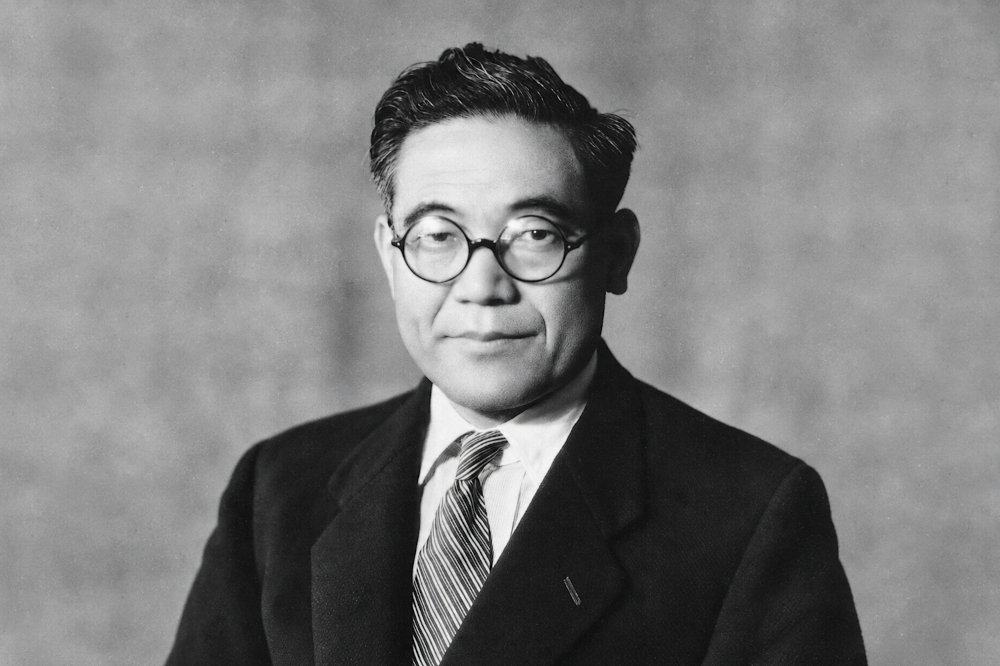
Pioneer of Just-in-Time and the Toyota Production System
Kiichirō Toyoda was the founder of Toyota Motor Co., Ltd. and a pioneer of the Just-in-Time principle. His idea of supplying parts only in the required quantities and precisely when needed laid an essential foundation for subsequent Toyota Production System, transforming production and logistics worldwide.
| Industry | Automotive Industry |
| Country | Japan |
| Last Position | President of Toyota Motor Co., Ltd., Aichi, Japan |
| Induction into the Logistics Hall of Fame | 2026 |
-
Merits
- Kiichirō Toyoda was born on 11 June 1894 in what is now the city of Kosai in Shizuoka Prefecture. He was the son of Sakichi Toyoda, one of Japan’s most important inventors and entrepreneurs of his time. With his automatic looms, Sakichi Toyoda had already laid the foundation for what would later become the Toyoda Group.
- After graduating in engineering, Kiichirō Toyoda joined the family business, Toyoda Automatic Loom Works. During a journey through Europe and the United States in 1929 and 1930, he studied industrial manufacturing and the emerging automotive industry in depth. He recognized that the automobile would also become a key economic factor in Japan.
- The decision to enter automobile manufacturing involved considerable risks. The Japanese market was dominated by foreign manufacturers, technological expertise was scarce, and the family business specialized in textile machinery. Nevertheless, Kiichirō Toyoda pursued his vision with determination. In 1933, Toyoda Automatic Loom Works established its own automobile division. The A1 passenger car prototype was completed in May 1935, followed by the AA passenger car and the G1 truck. On 28 August 1937, the automobile division became an independent company under the name Toyota Motor Co., Ltd. Kiichirō Toyoda initially served as Executive Vice President and became President in 1941.
- A Factory for a New Kind of Production
- Under Toyoda’s decisive leadership, Toyota’s first major automobile plant was built in Koromo, now Toyota City. Completed in 1938, the plant was more than a new production facility: it embodied a fundamentally new manufacturing concept. Toyoda sought to create a continuous production flow. The individual production stages were to be closely interconnected, and materials were no longer to be stored in large quantities. Instead, the required parts were to arrive at the assembly line precisely when they were needed.
- This concept was vital to Toyota’s survival. The company had neither the financial resources nor the large, homogeneous market available to American automobile manufacturers. Toyota needed to produce different vehicle models economically in small volumes while using capital, materials, and production space as efficiently as possible.
- The Birth of Just-in-Time
- Kiichirō Toyoda formulated the central idea: Each production stage should receive only what it actually required—in the necessary quantity and at precisely the right time. This gave rise to the Just-in-Time principle. It aimed to reduce work-in-progress inventories, shorten lead times, eliminate unnecessary work, and expose disruptions in the production process at an early stage. Toyoda did not focus solely on individual machines or workstations. He considered the entire material flow—from suppliers through the various production stages to final assembly. Production and logistics were to be organized as one integrated system.
- This systemic perspective was pioneering. It differed fundamentally from conventional production methods, which manufactured large volumes regardless of actual demand and subsequently held them in extensive inventories.
- The American Influence
- Kiichirō Toyoda’s travels through the United States and Europe reinforced his conviction that Japan needed an automobile industry of its own. He studied Western production methods but also realized that American mass production could not simply be transferred unchanged to Japanese conditions. Toyoda’s achievement therefore did not consist of merely copying American factories. He adopted suitable technical and organizational ideas, adapted them to Japan’s particular circumstances, and developed an independent approach.
- The frequently repeated story that the Toyota system was inspired by the replenishment principle used in American supermarkets, by contrast, primarily relates to Taiichi Ōno’s later development work. It was not the origin of Kiichirō Toyoda’s Just-in-Time concept and should be distinguished from Toyoda’s own contribution.
- Two Generations—Two Fundamental Principles
- Kiichirō’s father, Sakichi Toyoda, also made an important contribution to Toyota’s later production principles. His automatic looms could stop themselves whenever a thread broke. This prevented an unnoticed fault from producing further defective products.
This technical principle evolved into Jidōka: Machines and production processes should detect abnormalities and stop when problems occur. Quality is therefore assured directly within the process rather than inspected only at the end. - Sakichi Toyoda’s Jidōka principle and Kiichirō Toyoda’s Just-in-Time vision later became the two central pillars of the Toyota Production System.
The implementation of Kiichirō Toyoda’s ideas was severely hindered by war, shortages of raw materials, and economic crises. During the Second World War, Toyota had to focus its production largely on trucks required for military purposes. After the war, capital, materials, and customers with sufficient purchasing power were scarce. Despite these difficult conditions, Toyoda remained committed to his long-term vision. He wanted to develop Toyota into an independent, technologically advanced automobile manufacturer capable of producing high-quality vehicles with limited resources. - Kiichirō Toyoda died on 27 March 1952 at the age of only 57. He did not live to witness the subsequent global success of his production concept.
- From the Just-in-Time Concept to the Toyota Production System
- After Kiichirō Toyoda’s death, Toyota continued to develop his ideas systematically. Taiichi Ōno and numerous other engineers transformed the fundamental Just-in-Time concept into a comprehensive and practically applicable production system. Ōno has already been inducted into the Logistics Hall of Fame for his distinct contribution.
- The Toyota Production System was not the invention of any single individual. Kiichirō Toyoda, however, set its decisive direction: Production should be aligned with actual demand, materials should be available at precisely the right moment, and both tied-up capital and waste should be reduced to a minimum. The term “Lean Production,” coined later in the West, brought many of these principles to international prominence. Kiichirō Toyoda himself did not use the term, but his thinking provided an essential foundation for it.
- Today, the Toyota Production System is regarded as a benchmark for efficient, flexible, and quality-oriented production systems. Its principles are applied far beyond the automotive industry—in logistics, mechanical engineering, retail, healthcare, and many other sectors.
- Kiichirō Toyoda’s historical achievement extends far beyond the founding of an automobile company. He recognized early on that Toyota could succeed only with an independent production and logistics model. With his Just-in-Time vision, he created the conceptual starting point for one of the most influential production systems in industrial history.
-
Vita
June 11, 1894 Born in Kosai, Shizuoka Prefecture, Japan
1916 Graduated in Mechanical Engineering from Tokyo Imperial University
1926 Joined the family business, Toyoda Automatic Loom Works
1933 Assumed leadership of the Automotive Division of Toyoda Automatic Loom Works
August 23, 1937 Founded Toyota Motor Corporation
1937-1939 Developed the first prototype of the A1 passenger car
1937-1940 Oversaw construction of the first Toyota automobile factory in Koromo (now Toyota City)
1941 Began mass production of Toyota vehicles
1945 End of World War II and reconstruction of the company
1950 Introduction of the Toyota Production System (TPS)
March 27, 1952 Passed away at the age of 57
2026 Inducted into the Logistics Hall of Fame
-
Background Video
Copyright: Toyota Motor Corporation
Fotos: LHOF/Wikipedia Commons/edited with AI