CMR Convention



Development, Implementation and Digitalisation of the CMR Convention
The CMR Convention ("Convention relative au contrat de transport international de marchandises par route"), developed under the auspices of the United Nations Economic Commission for Europe (UNECE), was adopted in Geneva on 19 May 1956 and entered into force in 1961. It established a common legal framework for international road freight transport and remains one of the most important international regulations governing the logistics and transport industry. In particular, the CMR consignment note serves as the key accompanying document in international road freight transport.
| Industry | Public Administration, Associations |
| Country | Palais des Nations, CH-1211 Geneva 10, Switzerland |
| Represented by | United Nations Economic Commission for Europe (UNECE) |
| Inducted into the Logistics Hall of Fame | 2026 |
-
Merits
- The Convention on the Contract for the International Carriage of Goods by Road – commonly known as the CMR Convention ("Convention relative au contrat de transport international de marchandises par route") – was adopted in Geneva on 19 May 1956 and entered into force in 1961. It was developed under the auspices of the United Nations Economic Commission for Europe (UNECE) to standardise international road transport contracts, liability provisions and documentation requirements. Its objective was to harmonise the fragmented legal regulations governing cross-border road freight transport in post-war Europe and thereby facilitate international trade.
- For the first time, the CMR Convention established a uniform contractual and liability regime for international road transport. Among other things, it regulates:
- the rights and obligations of consignors, carriers and consignees,
- liability for loss, damage or delay in delivery,
- claims procedures and limitation periods,
- and documentation requirements for international road transport.
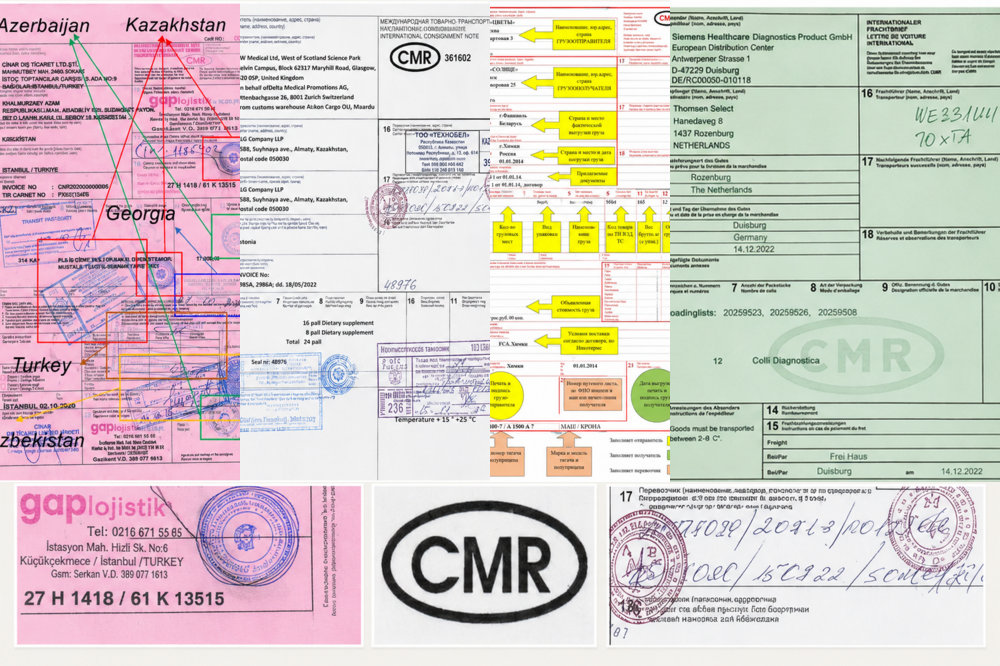
- Of particular significance was the introduction of the mandatory CMR consignment note. To this day, it serves as the principal accompanying document in international road freight transport and contains standardised information on the consignor, consignee, type of goods, weight, transport route and carrier. This standardisation made cross-border freight transport considerably more efficient, transparent and legally secure.
- Today, the CMR Convention is regarded as one of the most important international regulatory frameworks in logistics and transportation. 58 countries have acceded to the Convention, including virtually all European nations as well as numerous countries in Asia, North Africa and the Middle East. According to UNECE, approximately, on average, from unofficial statistics, more than 800mln CMR Consignment Notes are issued every year under the provisions of the CMR Convention. It therefore constitutes a central legal foundation of international road freight transport.
- Historically, the CMR Convention marked an important step in Europe’s economic integration after the Second World War. The rapid growth of international trade in the 1950s created a need for uniform rules to remove barriers to trade and support the increasing international division of labour. The Convention made a major contribution to creating more predictable and efficient international supply chains.
- The CMR liability regime is of particular importance. In principle, carriers are strictly liable for loss of or damage to goods occurring between acceptance and delivery. At the same time, the Convention limits liability to defined maximum amounts, thereby creating an internationally predictable risk allocation system. This standardisation was a key factor in the professionalisation of European road freight transport.
- Today, the future of the CMR Convention is increasingly shaped by digitalization. The Additional Protocol concerning the electronic consignment note – known as the eCMR Protocol – established the legal basis for the electronic handling of the CMR consignment note. As a result, transport data can be captured, transmitted and archived digitally. As of today, 42 UN member States have become contracting parties to the additional protocol on eCMR. The eCMR protocol refers to the Consignment note but also to all the processes being described in the CMR convention.
- Back in 2022, the UNECE Working Party on Road Transport (SC.1) which administers all the UN road transport Convention including the CMR Convention, established an official group of experts from Governments and the Private sector to discuss and prepare the conceptual and functional specifications required for the operationalization of the eCMR protocol. Those specifications were prepared and adopted by the Inland Transport Committee of UNECE in February 2026 setting the concrete basis for making electronic CMRs a reality. The proposed conceptual and functional specifications and the revised UN/CEFACT eCMR data standards (work is ongoing) will be made available as United Nations public goods, ensuring that they remain nonobligatory but widely accessible; Governments are invited to encourage anyone wishing to develop an eCMR application to use these United Nations public goods.
- It should be noted, that in order for the electronic CMRs to be operational in international context fully covering the requirements of the CMR Convention, an eCMR ecosystem of 3 steps should be developed having all stakeholders, governmental and private, involved.
- Applications should be developed at national level – following if possible, the proposed UNECE functional specifications – that generate electronic CMR consignment notes following all processes and data requirements stipulated in the CMR Convention.
- The UNECE/UNCEFACT data standards on eCMR as revised following the functional specifications should be used in order to ensure interoperability among those applications in international environment.
- Governments, since public authorities such as customs, police, courts are using the CMR Consignment notes and should have access to the original data generated for electronic CMRs, should act and agree on the secured exchange of such a data. The eFTI platform in EU or the pilot projects undertaken under EDI in other regions are good practices implemented for such secure exchange of transport data.
- The United Nations Economic Commission for Europe (UNECE) itself was established in 1947 by the United Nations Economic and Social Council (ECOSOC). Its mission is to promote economic cooperation and integration among the member states of Europe and neighboring regions. Over the decades, UNECE has developed numerous technical and legal standards for trade, transport and infrastructure. In addition to the CMR Convention, it has also provided the framework for many other important international regulations in Road Safety, Vehicles Regulations, Dangerous Goods, Border Crossing Facilitation (TIR) including those governing rail, inland waterways and intermodal transport and Logistics In total, the Inland Transport Committee of the Sustainable Transport Division of UNECE is the custodian of 61 UN Inland Transport Conventions.
-
Background Video
Photos: LHOF / UNECE / UN-photo-Jean-Marc-Ferré / created with KI
Video: IRU